


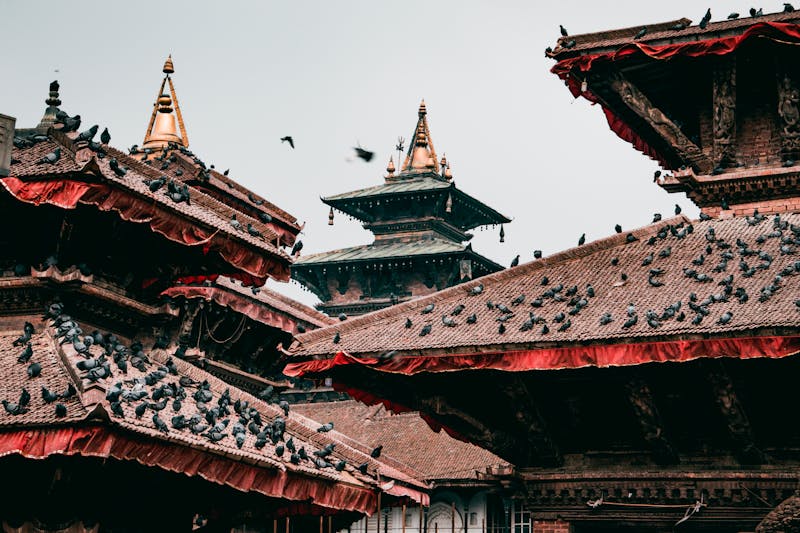


A storm diverted Vasco da Gama's ship to Kochi in 1500. He came for kurumulaku — Malabar black pepper, then worth its weight in gold. He left behind the first seed of the European empire in Asia. Over the next four centuries, four imperial powers would build — and defend, and lose — the tiny cape that is today Fort Kochi.
Chinese nets, Jewish traders, Portuguese priests
Long before Europe arrived, Kochi was already cosmopolitan. Chinese fishing nets (called cheena-vala) were gifted to the Kochi king by a visiting court from Kublai Khan around 1350 — they still line the northern shore and are still worked by five-men teams at every tide. The Paradesi Synagogue was built in 1568 by Sephardic Jews who fled the Portuguese Inquisition in Cranganore; its blue-and-white willow-pattern Chinese tiles are older than New York. Two blocks away, St. Francis Church (1503) is the oldest European church in India and originally held the body of Vasco da Gama himself — his cenotaph is still inside, though his remains were taken back to Lisbon in 1539.
In 1663 the Dutch VOC wrested Kochi from the Portuguese and for the next 132 years ran it as the headquarters of their Malabar spice trade. They left behind the gambrel-roofed bungalows of Burgher Street and the Mattancherry Palace — which the Dutch renovated for the local Kochi king but never actually lived in, making it one of the world's only palaces built by Europeans as a diplomatic gift. When the British arrived in 1795, they mostly built warehouses. Independence (1947) and then the fall of the princely states (1949) finally ended 450 years of imperial succession. Today the buildings all share the same salt-stained walls.
A walking tour in one afternoon
- Start at the Chinese fishing nets at Vasco da Gama Square; tip the fishermen ₹50 to help lower them.
- Walk south to St. Francis Church — free entry, 3-minute visit, 500 years of history.
- Cut east to Santa Cruz Basilica — Portuguese, remodelled in Gothic Revival under the British.
- Cross over to Mattancherry Palace for the Kerala mural galleries (the longest Hindu mural cycle in Asia).
- End at Jew Town — the synagogue, antique shops, and the best Malabar biryani at Kayees Rahmathulla Hotel.
Kochi is the gateway, not the destination
Use Fort Kochi as the opening chapter of a full Kerala route. Three hours south by road or train is the slow heartbeat of the Alleppey backwaters, where a houseboat night costs less than a Kochi hotel. Four hours east, into the Western Ghats, the tea estates of Munnar rise out of the clouds — a natural cool-down after the coastal humidity. Heading north by road, Kochi is also the natural pairing for the quieter beaches of Portuguese Goa, which share much of Kochi's colonial vocabulary. See all of the state of Kerala or browse under Heritage.
“Kochi swallowed every invader and kept the spice recipe.”
About the author
YatraJunction Editorial
Our editors are travellers, historians and food lovers who have collectively visited every state of India. Every guide is fact-checked, field-tested and updated with love.
Learn about usFrequently asked questions
- How many days do I need in Fort Kochi?
- Two days is ideal — one for the heritage walking circuit and Jew Town, one for a Kathakali evening, Cherai Beach and the Hill Palace museum across the bay.
- Is Fort Kochi the same as Cochin or Ernakulam?
- No. Ernakulam is the mainland business district; Fort Kochi is a small peninsular quarter 15 minutes away by ferry. All three are part of the city officially called Kochi.
- When is the Kochi-Muziris Biennale?
- Every two years from December to April (next edition 2026–27). It is the largest contemporary art event in Asia; warehouses and old Dutch bungalows become pavilions.
Discover India
Planning a trip to India?
Most of our editors live and travel across India. Here are some of the destinations and stories worth bookmarking before you go.


